
9 Facts About French Mastiffs
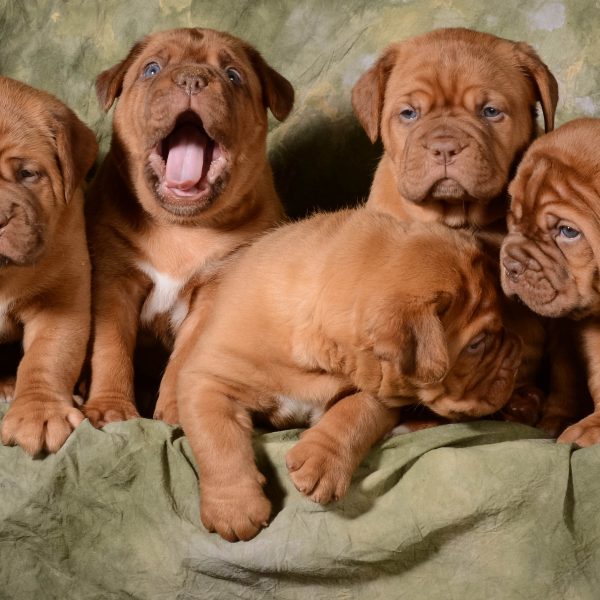
The Dogue de Bordeaux is also called the French Mastiff. These dogs are large, loyal protectors that love their families and are devoted to them. Here are a few more facts about French Mastiffs:
- They are an ancient dog breed.
- French Mastiffs served in various capacities throughout history.
- There used to be two varieties.
- They are a great fit for families.
- Properly socializing and training a Dogue de Bordeaux is essential.
- Turner & Hooch gave the Dogue de Bordeaux global recognition.
- French Mastiffs are more sensitive to heat.
- They are going to drool.
- French Mastiffs have the largest head-to-body proportion in canines.
1. They Are an Ancient Dog Breed
Although they are considered a French dog breed, the Dogue de Bordeaux is an ancient dog breed that predates France. The region they originated from was called Gaul at the time. Even so, their real origins stretch so far back into history that their beginnings are mostly theorized.
One theory is that these dogs were indigenous to the area of Gaul and were developed over thousands of years. The prevailing theory is that they are descendants of the mastiff-type war dogs that Romans brought into the area.
2. French Mastiffs Served in Various Capacities Throughout History
Although their specific origins are more theory than fact, what we do know from the history we do have is that the Dogue de Bordeaux dog breed served in several different capacities throughout history.
Much like their likely war dog ancestors, they were used as war dogs and fighting dogs during their early history. Then, they moved into roles as drafters on farms, guardians, and also worked as hunting dogs. Before the French Revolution, they were a popular choice for working as a guard dog for noble estates.
After the French Revolution, the dog breed worked as a farm dog. They protected, herded, and drove livestock. Thanks to these skills and the value they provided to their owners, the Dogue de Bordeaux was able to survive the revolution and continue to thrive in France before they made their global debut in the 1980s.
In modern times, the French Mastiff can still be found working on farms. In addition to that, they can also be found working in search and rescue or as therapy dogs. And, of course, they are commonly found as a beloved canine companion to their owners.
3. There Used to Be Two Varieties
This dog breed used to come in two distinct varieties: the Dogue and the Doguin. The Dogue is the larger version of the breed, which we still know today. The Doguin de Bordeaux was a considerably smaller breed that faded out of existence long ago. The Doguin disappeared from historical records after the 1700s. The Dogue almost went extinct as well, like many dog breeds after wars.
It’s likely that the breed diminished during the French Revolution and did not recover after it as the Dogue did. Since the Dogue de Bordeaux was larger and stronger, that meant they could take on work as a guardian and as a strong, versatile farm dog. It’s likely that those reasons are why the Dogue was able to survive and repopulate as a breed, even after facing near-extinction after the World Wars, while the Doguin disappeared.
4. They Are a Great Fit For Families
Although they are one of the largest dog breeds in the world and French Mastiff puppies grow into large, intimidating dogs, they are actually sweet and sensitive dogs that are affectionate with their families.
They get along fantastically with children. Although they can knock over a small child in their excitement, even as puppies, they tend to be gentle and careful with children as long as they are properly socialized and trained.
5. Properly Socializing a Dogue de Bordeaux is Essential
The Dogue de Bordeaux is a big dog with a protective instinct. They are naturally wary of strangers and strange dogs. Because of this, proper socialization and training early and throughout their life are essential for a French Mastiff puppy to grow into a well-balanced dog.
Socialization and training are important for any dog breed, but it is essential for dogs with a protective instinct so they do not become aggressive with unfamiliar people or new situations. A well-socialized and trained Dogue de Bordeaux will likely always be initially wary of strangers. However, once they are introduced, they tend to warm up quickly.
6. Turner & Hooch Gave the Dogue de Bordeaux Global Recognition
Although the Dogue de Bordeaux did become known outside of France, they didn’t have common global recognition until after the original Turner & Hooch movie was released in 1989. Hooch was the canine companion to Scott Turner in their comedic buddy-cop relationship and became a famous dog.
Hooch was portrayed by a dog actor named Beasley, a dog stunt double named Igor, and a few other dogs throughout production. All dogs involved with the Hooch role in this movie were Dogue de Bordeaux. After the release of the movie, people around the world fell in love with the breed and gave the Dogue de Bordeaux a bigger spotlight on the global stage.
The Return of Turner & Hooch in 2021
The Dogue de Bordeaux reprised the role of Hooch in the 2021 Turner & Hooch series on Disney+. This time around, five different Dogue de Bordeaux worked to portray the role of Hooch. Their names were Obi, Arnie, Hammer, Cyd, and Maya. Obi was the oldest, sire to Cyd, and a show dog champion. He won Best in Breed at the 2020 Westminster Kennel Club Dog Show! One of his specialties was close-up “drool shots.”
Cyd, Obi’s son, was the youngest and was considered the “King of rollovers and belly ups.” Arnie was known for his “consecutive barking.” Hammer was known on set for being the most like Hooch and was considered the best at stunts. Mya was the only female Dogue on set. If Hooch is pulling everything off a table or desk in the show, Mya was probably the one doing it.
7. French Mastiffs Are More Sensitive to Heat
The Dogue de Bordeaux is a large, snub-nosed dog breed. This means French Mastiffs are very sensitive to heat, even more so than dogs with longer snouts. This makes them prone to overheating, so you need to be careful when working with them during warmer temperatures.
Planning activity for cooler times of the day, working in short bursts, taking breaks, making sure water is available, and more are all safe ways to exercise flat-faced dogs that you can use to make sure your French Mastiff gets enough exercise without overheating.
8. They Are Going to Drool
These dogs are known for their large size, facial wrinkles, and droopy jowls. This means that they are dogs that are more prone to drooling. If you have a Dogue de Bordeaux, just know that they are going to drip water after they drink and are going to drool. It’s not a bad idea to have a drool cloth on hand to wipe up occasionally when you need to.
9. French Mastiffs Have the Largest Head-to-Body Proportion in Canines
The Dogue de Bordeaux is widely recognized as having the largest head-to-body proportion in the canine kingdom. They are known for their large size, including their big heads and deep wrinkles. Their body is muscular and stocky. They aren’t the largest dog breed, but they are still huge dogs.
Although they don’t have the largest head of the dog kingdom, they do have the largest head-to-body proportion. The huge, broad head, thick muzzle, and undershot jaw contribute to their massive size and are why their crown takes the crown for the largest head-to-body ratio among dogs.
Is a French Mastiff Puppy Right For You?
These are just a few facts about French Mastiffs. French Mastiff puppies are a good fit for single owners and families who can give them the exercise, mental stimulation, training, and attention they need to be happy and healthy. If you think this could be the right dog breed for you, learn more about them and then take a look at the available French Mastiff puppies! You could end up finding your new best friend!