
-
Activity Level:
high

-
Shedding Level:
low

-
Grooming Level:
moderate
-
Trainability:
high
-
Good for Novice Owners:
moderate
-
Adaptability:
moderate
-
Kid/Pet Friendly:
often
-
Prey Drive:
high
-
Watchdog:
aware
- Average Size: Medium
- Average Lifespan: 10-13 years
- Registered?: other
Chesa-Poo Dog Breed Information
Overview
Temperament
Adaptability
Health
Owner Experience
Grooming
Activity Level
Size
Life Span
Did You Know?
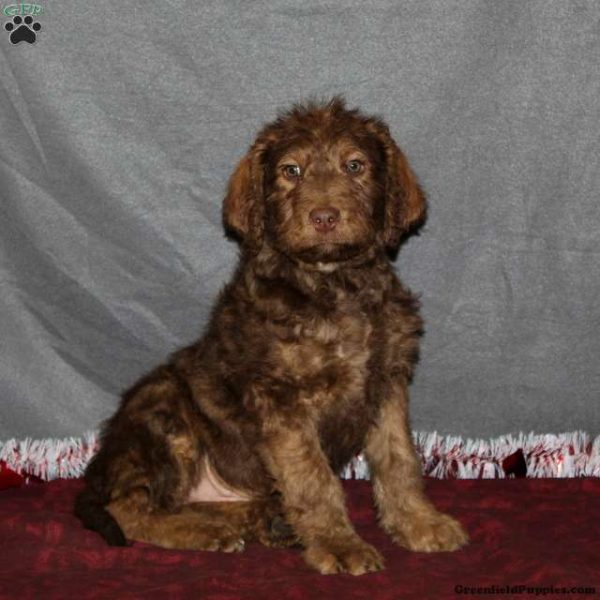
The Chesa-Poo, of Chesadoodle, is a designer dog breed that is a mix between a Chesapeake Bay Retriever and a Standard Poodle. Although a mixed-breed can take on any combination of characteristics from one or both of the parent breeds, a Chesa-Poo tends to be friendly, affectionate, and energetic.
Although the Chesa-Poo is not currently recognized by the American Kennel Club because they are not a purebred dog, they are recognized by other notable dog organizations. The Designer Dogs Kennel Club, Designer Breed Registry, International Designer Canine Registry, and more all recognize the Chesa-Poo.
The Chesa-Poo tends to be an intelligent dog with a friendly disposition and a playful personality. They tend to have a high prey drive, so they may have an urge to chase smaller animals. As such, some extra socialization with other small pets in the household may be required.
However, their patient and gentle nature means they tend to get along fantastically with children. Chesadoodles also tends to get along well with other dogs and strangers, provided they are well-socialized. One of the facts about Chesapeake Bay Retrievers and Poodles is that they make great family dogs, and the same is true for the Chesa-Poo.
They tend to be great family dogs that bond closely with their humans and are affectionate with them. They will also often bark to alert you, but don’t tend to go overboard with it, unless they have been trained into it. It’s not a bad idea to train your dog to stop barking early on to keep it from becoming a nuisance.
This is a moderately adaptable dog breed. Due to their larger size and high energy, the Chesa-Poo is better suited to larger homes with fenced yards where they can run. They can adapt to apartment living. However, you will need to dedicate plenty of time every day to making sure your Chesadoodle gets the mental stimulation, exercise, and attention they need to be happy and healthy.
They do tend to do well in most climates. But, as with most dogs, they are sensitive to heat and to extreme cold. Because they bond so closely with their families and thrive on human affection and attention, they do not like to be left alone for long periods of time. Plus, they have a lot of energy and get bored easily, so too much alone time without an outlet can result in destructive behavior.
Although a mixed-breed can sometimes “win the genetic lottery” and inherit none of the health conditions common to either of their parent breeds, this is not a guarantee. A mixed-breed can inherit the potential health conditions common to one, both, or neither of their parent breeds. Good breeding practices and the health of the parents make a big difference in the health of Chesa-Poo puppies.
For the Chesa-Poo, potential health concerns can include hip dysplasia, elbow dysplasia, digestive issues, retinal dysplasia, and entropion. Reputable breeders will screen their stock to avoid passing on genetic issues to puppies. So, don’t be afraid to ask the breeder about the genetic history of the parents. You can also ask to see any relevant health clearances or test results.
A Chesa-Poo tends to be highly intelligent and eager to please. This makes them a highly trainable dog that tends to pick up on things quickly. But, they also tend to have a stubborn streak, have a lot of energy, and get bored easily.
This can be a challenge for first-time dog owners. Puppy training classes can be a big help. Regardless of owner experience, puppy training classes can still be a good idea as they can offer opportunities to socialize a puppy, strengthen the bond you’re building with your puppy, and more.
Although having a Poodle in the mix may result in a low-shedding coat, this is not a guarantee for a Chesadoodle. Also, a low-shedding coat does not always mean low-maintenance.
Should your Chesa-Poo inherit the Poodle coat, they will be low-shedding, but will need to be brushed daily and professionally groomed every 4-6 weeks. Should they take after their Chesapeake Bay Retriever parent, they will shed regularly year-round, but they will only require brushing a few times a week and the occasional bath. They could also end up with a combination dog coat type that is somewhere in between.
In addition to coat care, you will also need to care for your Chesa-Poo’s nails, ears, and teeth. Once or twice monthly nail trimming is usually sufficient to keep them from growing too long. But, if your dog’s nails aren’t wearing down enough naturally or just grow quickly, you may need to cut your dog’s nails more often.
Checking weekly and carefully cleaning your dog’s ears as needed can help prevent ear infections. When you look at them, you’re checking to make sure ears are dry, clean, free of debris and pests, and that there is no excess wax, redness, or irritation. If you do see anything concerning, you’ll be able to catch it early and get to the vet.
It’s also important to practice good dental care for dogs. Due to a lack of good, consistent dental care early on, gum disease has become one of the most common health issues in dogs. By brushing your dog’s teeth or using an enzyme toothpaste every day, in addition to cleanings at the vet when needed, you can help prevent painful dental diseases like gum disease, tooth decay, or tooth loss later in life.
The Chesa-Poo is a high-energy dog breed. Daily walks, plus some extra activity and/or time to run, should be enough exercise to keep this dog happy and healthy. However, they will likely be up for more activity if you are.
Taking a trip to the dog park, especially one where they can run off-leash, is a great outlet. You can also try other activities like hiking with your dog, going for a swim, playing fetch or frisbee, and more. Just make sure to keep activities low-impact until puppies finish growing to avoid damage to developing bones and joints.
A fully-grown Chesa-Poo usually stands 19-24 inches tall at the shoulder and weighs 40-80 pounds.
Chesadoodles generally live for 10-13 years, on average.
With both parent breeds being dog breeds that love the water, it’s likely your Chesa-Poo will be a water dog, too. And, swimming is a great low-impact activity for dogs of all ages. Take it slow, make sure they have a life vest for dogs, and monitor them as you introduce your Chesa-Poo to swimming. You can always consult your vet before jumping in if you have any questions or hesitations.