
-
Activity Level:
high

-
Shedding Level:
low

-
Grooming Level:
high
-
Trainability:
high
-
Good for Novice Owners:
moderate
-
Adaptability:
high
-
Kid/Pet Friendly:
often
-
Prey Drive:
low
-
Watchdog:
aware
- Average Size: Medium
- Average Lifespan: 10-12 years
- Registered?: other
Flandoodle Dog Breed Information
Overview
Temperament
Adaptability
Health
Owner Experience
Grooming
Activity Level
Size
Life Span
Did You Know?
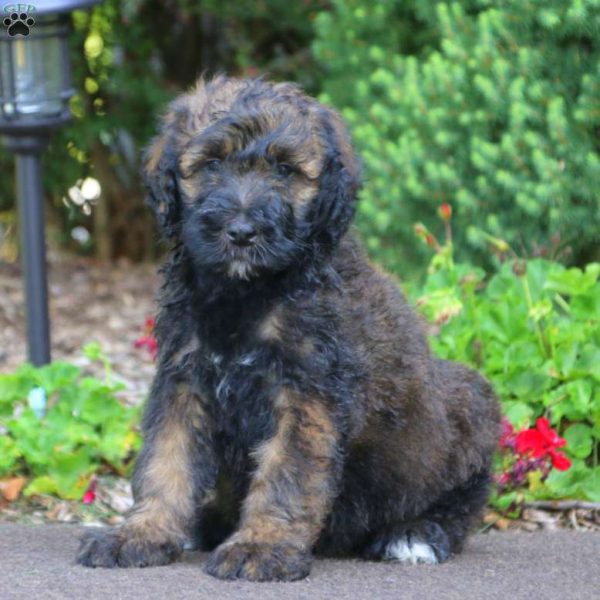
The Flandoodle is a cross between a Bouvier des Flandres and a Standard Poodle. These large dogs are loyal, devoted, and protective of their families. They are also smart, energetic dogs with playful personalities who are loving and affectionate.
As a newer designer breed, the Flandoodle is not currently recognized by the American Kennel Club. However, they can currently be registered with the Dog Registry of America.
These dogs make great companions and family dogs. One of the facts about the Bouvier des Flandres and Poodles that is also true for Flandoodles is that they tend to have a gentle nature, cheerful disposition, and playful personality. Those traits, in addition to their affectionate nature and intelligence, make them a perfect fit for families.
Flandoodles thrive on attention and affection, so they love being the center of attention. As long as they are properly socialized, these dogs tend to be quite friendly. They’re known to get along with children, other dogs, and other pets. They even tend to warm up quickly to strangers once introduced!
A Flandoodle is a highly adaptable dog. They are best suited for homes with fenced yards where they can run. But they can adapt to apartments as long as they get enough daily exercise, mental stimulation, and attention.
They do well in most climates. As with any dog breed, they are sensitive to heat. But their fluffy coats tend to give them a little bit more insulation against the cold. However, they may still need some winter dog products to stay warm while out on walks when the temperature drops.
Because these dogs are protective, thrive on attention, and bond closely with their families, they do not like to be left alone for long periods of time. They can also be prone to developing separation anxiety if you do not work with them on it early.
Although a mixed-breed dog can sometimes be healthier than a purebred dog, it’s not a guarantee. Just as they could inherit none of the conditions common to their parent breeds, they could also end up with all of them or some of them.
Potential health concerns to be aware of in a Flandoodle can include patellar luxation, Cushing’s disease, Addison’s disease, hip dysplasia, elbow dysplasia, epilepsy, eye problems, and skin conditions. Good breeding practices and the health of the parents make a big difference in the health of Flandoodle puppies.
Reputable breeders will screen their dogs to avoid passing preventable issues to puppies. So, make sure you ask about the health and genetic history of both parents. As a large dog breed, the Flandoodle is also at risk for bloat, so you want to learn about how to reduce the risk of bloat in dogs and learn the symptoms, so you know if you need to get to the emergency vet.
Although the Flandoodle is highly intelligent, sensitive, and eager to please, they are also high-energy dogs that get bored easily. They need a patient and firm owner who can keep training consistent, interesting, and focused on praise and positive reward.
This can be a challenge for first-time dog owners. Because of this, puppy training classes or a professional trainer are recommended. Even if you don’t need them, there are several big benefits of puppy training classes, including socialization, so they tend to be a good idea.
With some of the fluffiest dog breeds as parents, you can bet the Flandoodle will also have a fluffy coat. The Flandoodle will have a rough coat that ranges from shaggy to the classic Poodle curls. They can have a coat that is more like one parent or the other, or a combination of both.
One of the facts about Poodles that is also true for Flandoodles is that their coat may not shed a lot, or at all, but they will require some effort in grooming. You need to brush this dog’s coat daily to remove tangles and prevent mats. Bathing is on an as-needed basis, and professional grooming is recommended every few months at least, if not more often. With a more typical Poodle coat, professional grooming is recommended every 4-6 weeks.
In addition to coat care, you will also need to take care of your Flandoodle’s nails, ears, and teeth. If you’re visiting the groomer regularly, they’ll be able to handle some of it. But, you will still need to do some care and maintenance between appointments.
Nail trims once or twice monthly help keep nails from growing too long. Weekly ear checks with cleanings as needed can help prevent ear infections. Daily dental care, like brushing teeth or using an enzyme toothpaste in addition to cleanings at the vet when needed, can help prevent dental diseases and other health issues related to them later in life.
Flandoodles are high-energy dogs, and they need an active owner who can give them enough daily exercise. Multiple daily walks plus some playtime and time to run are usually enough. However, this dog will likely be up for more activity if you are.
Thankfully, they tend to be athletic and versatile dogs. So, once puppies finish growing and your vet clears them for higher-impact activities, you can try out a lot of activities to find the ones that fit you and your Flandoodle the best.
Dog parks, frisbee games, running, and more can all be good activities for a fully-grown Flandoodle. Swimming is a great low-impact activity that your dog can do at almost any age, as long as they are up to it and cleared by the vet for it.
A fully-grown Flandoodle usually stands 22-28 inches tall and weighs 55-85 pounds. Fully-grown males tend to be 24-28 inches tall and weigh 65-85 pounds, while fully-grown females tend to be 22-27 inches tall and weigh 55-75 pounds.
Flandoodles generally live for 10-12 years on average.
The Flandoodle is also sometimes called a Bouvipoo, Flanpoo, Poovier, Bouvidoodle, Bouvierpoo, or Bouvierdoodle.